> ## Documentation Index
> Fetch the complete documentation index at: https://dev.jup.ag/docs/llms.txt
> Use this file to discover all available pages before exploring further.
# Organisations & Teams
> Group your teams under one organisation, each with its own keys, analytics, and logs.
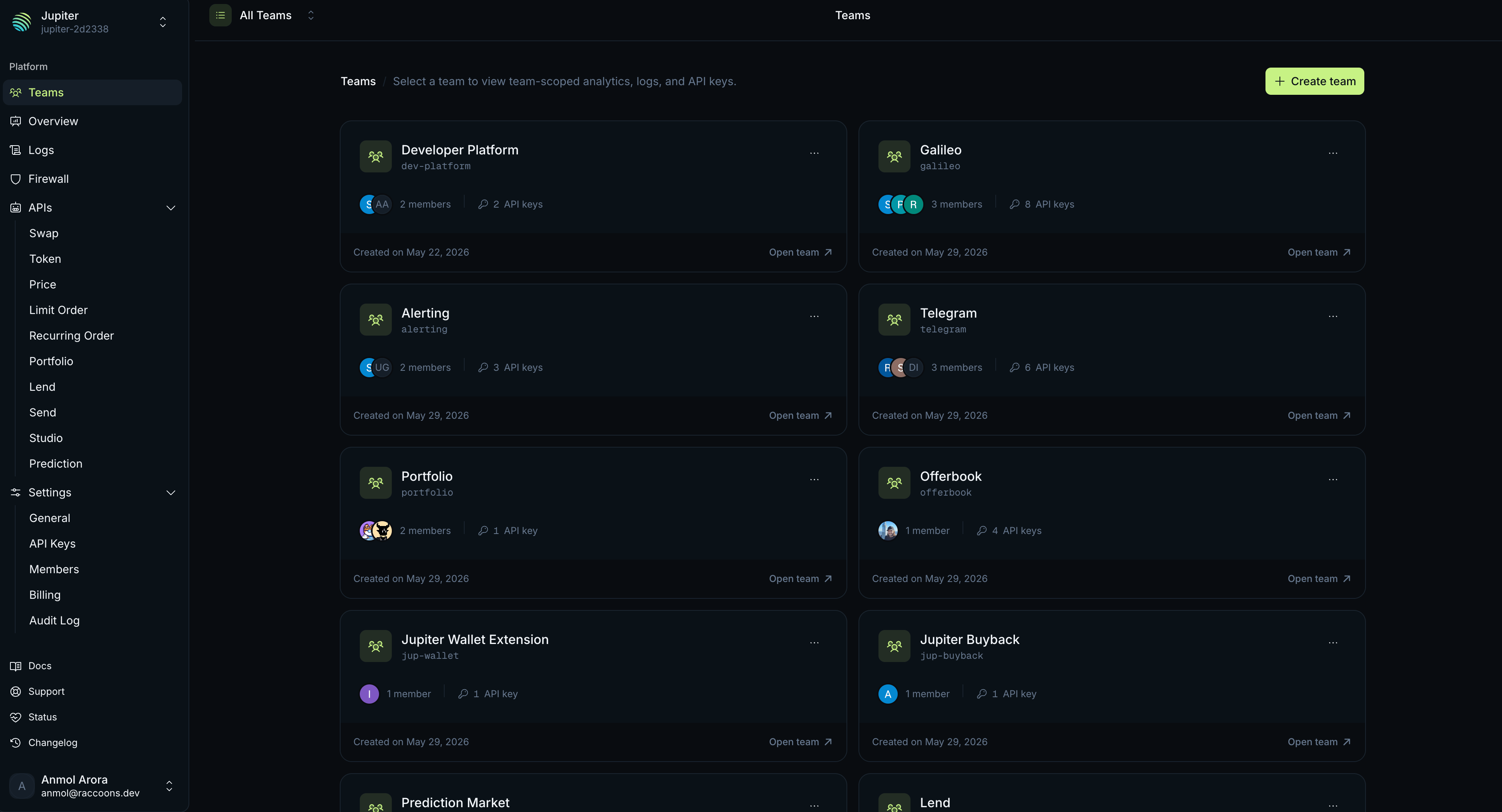
An organisation groups your teams. Each team has its own API keys, analytics, request logs, and firewall rules, so you can keep products or environments separate: production in one team, staging in another, or one team per app.
## Teams
Create a team for each product or environment you want to track on its own. A team holds its own:
* API Keys
* Analytics
* Request Logs
* Firewall Rules
Each team has a slug used in its Portal URL, `/portal/{org}/{team}`. Slugs are lowercase letters, digits, and hyphens, up to 48 characters, and unique within the organisation. If a name produces a slug that is already taken, Portal adds a short suffix to keep it unique. Switch between teams from the team selector in Portal.
Deleting a team permanently invalidates its API keys. Any request using those keys will be rejected.
 ## Members and roles
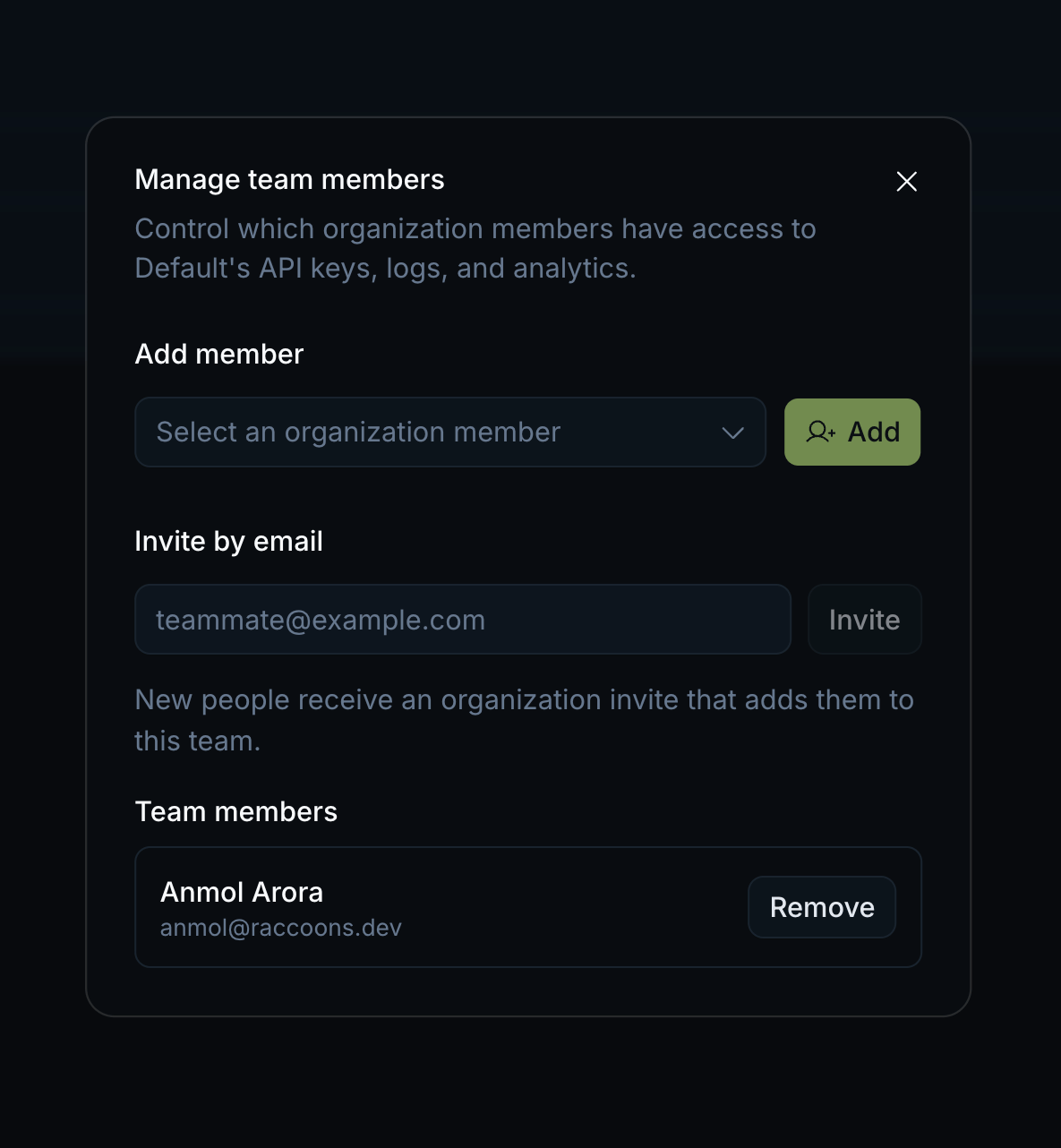
Invite people to your organisation by email. An invitation expires after 10 days.
An organisation has three roles: **owner**, **admin**, and **member**. Team membership is separate from the organisation role: you are either in a team or not, with no per-team roles.
### Who can do what
| Capability | Member | Admin / Owner |
| :------------------------------------------------------------------------------------ | :------------------------ | :------------ |
| View any team's [Analytics](/portal/analytics) and [Request Logs](/portal/logs) | Read-only | Read-only |
| Create, rename, delete, and set permissions on a team's [API Keys](/portal/api-keys) | Only teams they belong to | Any team |
| Create, edit, enable, disable, and delete a team's [Firewall](/portal/firewall) rules | Only teams they belong to | Any team |
| Upgrade, downgrade, or cancel the organisation's [plan](/portal/plans) | No | Yes |
| Invite or remove members, change roles | No | Yes |
An organisation can have multiple owners. To grant ownership, an existing owner promotes another member to owner. The original owner keeps their role unless they voluntarily demote themselves. An organisation must always have at least one owner: the last remaining owner cannot be demoted or removed.
## Members and roles
Invite people to your organisation by email. An invitation expires after 10 days.
An organisation has three roles: **owner**, **admin**, and **member**. Team membership is separate from the organisation role: you are either in a team or not, with no per-team roles.
### Who can do what
| Capability | Member | Admin / Owner |
| :------------------------------------------------------------------------------------ | :------------------------ | :------------ |
| View any team's [Analytics](/portal/analytics) and [Request Logs](/portal/logs) | Read-only | Read-only |
| Create, rename, delete, and set permissions on a team's [API Keys](/portal/api-keys) | Only teams they belong to | Any team |
| Create, edit, enable, disable, and delete a team's [Firewall](/portal/firewall) rules | Only teams they belong to | Any team |
| Upgrade, downgrade, or cancel the organisation's [plan](/portal/plans) | No | Yes |
| Invite or remove members, change roles | No | Yes |
An organisation can have multiple owners. To grant ownership, an existing owner promotes another member to owner. The original owner keeps their role unless they voluntarily demote themselves. An organisation must always have at least one owner: the last remaining owner cannot be demoted or removed.
 ## Related
Create and scope the keys that belong to each team.
Add rules that apply to a team's traffic.
Every member can view any team's analytics.
Every member can inspect any team's request logs.
## Related
Create and scope the keys that belong to each team.
Add rules that apply to a team's traffic.
Every member can view any team's analytics.
Every member can inspect any team's request logs.